

Pulleys are widely used in mechanical systems to transfer power, guide belts, change the direction of movement, or lift heavy loads. Although their basic structure is relatively simple, different pulley designs serve very different purposes.
Selecting the right pulley is important for maintaining transmission efficiency, reducing component wear, and ensuring stable equipment operation. Below is an overview of the most common pulley types and where they are typically used.
1. How Pulleys Are Classified
Pulleys can be grouped according to their function, drive method, or structural design.
Based on their function, common types include drive pulleys, idler pulleys, and tensioner pulleys. When classified by the transmission medium, they include V-belt pulleys, flat belt pulleys, timing belt pulleys, and rope or cable pulleys.
These categories may overlap. For example, a timing belt pulley is identified by both its toothed design and its use in a synchronous belt drive.
Understanding these differences makes it easier to select a pulley that matches the mechanical system.
2. Common Types of Belt Pulleys
Belt pulleys transfer rotational power between shafts through a belt. They are commonly found in industrial machinery, HVAC equipment, agricultural machines, and automotive systems.
V-Belt Pulleys
V-belt pulleys feature one or more trapezoidal grooves designed to match the cross-section of a V-belt.
As the belt sits inside the groove, the wedging effect increases friction between the belt and pulley. This helps transmit power while reducing slippage under normal operating conditions.
V-belt pulleys are suitable for applications requiring reliable power transmission, including pumps, compressors, fans, and industrial machinery.
Flat Belt Pulleys
Flat belt pulleys have a smooth running surface and are designed for use with flat belts. Many feature a slightly crowned surface, which helps keep the belt centered during operation.
Compared with V-belt systems, flat belt drives can operate smoothly at relatively high speeds and produce less noise. They are often used in textile machinery, machine tools, and other high-speed equipment.
However, flat belts generally require a wider contact surface to transmit comparable power.
3. Idler Pulleys
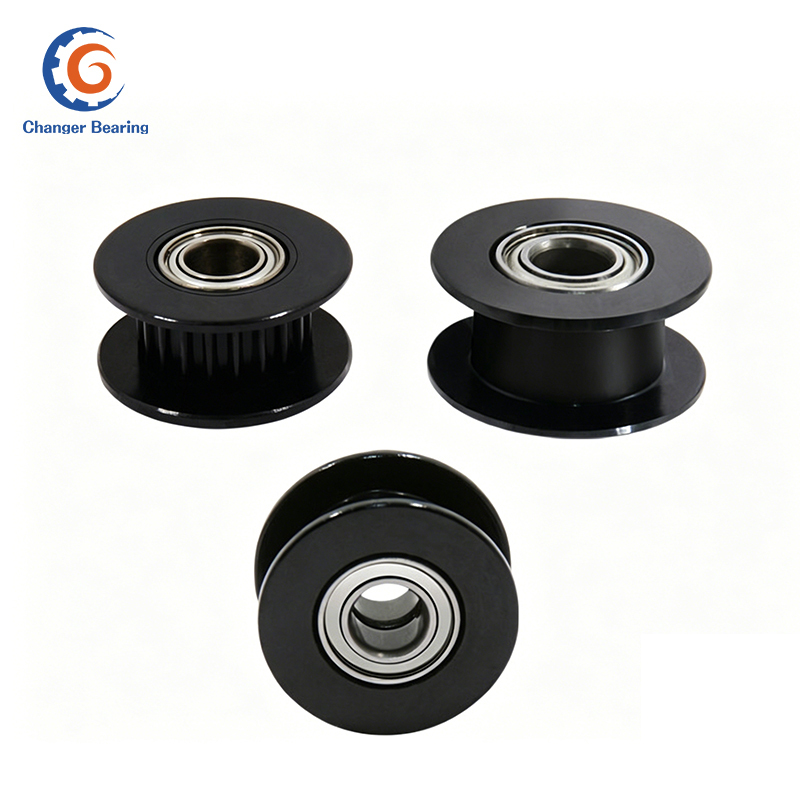
Unlike drive pulleys, idler pulleys do not transfer driving power from a motor to a shaft. Their main purpose is to guide the belt, support its movement, or maintain proper belt tension.
There are two common arrangements:
Tensioner idlers: Apply or maintain tension on the belt, helping prevent excessive slack.
Guide idlers: Change the belt's direction or increase the contact angle between the belt and drive pulley.
Idler pulleys are commonly used in automotive belt systems, conveyors, and industrial equipment.
Many designs incorporate sealed ball bearings to allow smooth rotation. Bearing wear, contamination, insufficient lubrication, and excessive belt tension can all contribute to premature failure. Unusual squealing or grinding noises may indicate that the pulley bearing needs inspection.
4. Rope and Cable Pulleys
Rope and cable pulleys are designed to guide ropes or wire cables during lifting, pulling, and load-handling operations.
The grooved wheel is often called a sheave. In lifting equipment, the complete pulley assembly may also include a frame, axle, bearings, and mounting components.
The groove must be compatible with the rope or cable diameter. If the groove is too wide, the rope may move excessively and wear unevenly. If it is too narrow, the rope can become pinched, increasing friction and the risk of damage.
Common applications include construction equipment, cranes, marine systems, mining machinery, and lifting devices.
Pulley arrangements also affect mechanical advantage:
| Configuration | Theoretical Mechanical Advantage | Main Function |
|---|---|---|
| Fixed pulley | 1:1 | Changes the direction of force |
| Movable pulley | 2:1 | Reduces the required pulling force |
| Compound pulley | Depends on the arrangement | Combines multiple pulleys to lift heavier loads |
Actual lifting performance is affected by friction, bearing condition, and equipment efficiency. Rated load limits must always be observed.
5. Timing Belt Pulleys
Timing belt pulleys have precisely machined teeth that engage with the teeth on a synchronous belt. Unlike conventional V-belt and flat belt drives, this engagement prevents normal belt slippage and maintains a consistent speed relationship between connected shafts.
This makes timing belt pulleys suitable for equipment where accurate motion and synchronization are important, such as CNC machines, robotics, packaging equipment, and automotive timing systems.
Tooth geometry is an important consideration. Trapezoidal and curvilinear profiles are common designs, and the pulley must match the belt's pitch and tooth profile.
Timing belt pulleys are generally manufactured from aluminum alloy, steel, or other suitable engineering materials. Aluminum is often selected for its low weight and machinability, while steel may be preferred for applications involving higher loads or demanding operating conditions.

6. How to Choose the Right Pulley
The correct pulley depends on the transmission method, operating conditions, and mechanical requirements. Before selecting a model, consider the following factors:
1. Identify the transmission method
Determine whether the system uses a V-belt, flat belt, timing belt, rope, or wire cable. The pulley groove or tooth profile must be compatible with the selected transmission component.
2. Understand the pulley's function
A drive pulley transfers power, while an idler pulley guides the belt or controls tension. For lifting applications, the pulley arrangement should match the required load and mechanical advantage.
3. Check load and operating speed
Consider the transmitted torque, rotational speed, belt tension, and expected operating hours. These factors influence pulley size, material, and bearing requirements.
4. Consider the working environment
Moisture, dust, chemicals, and temperature can affect pulley performance. Corrosion-resistant materials and sealed bearings may be necessary in demanding environments.
5. Verify installation dimensions
Check the bore diameter, shaft fit, groove dimensions, tooth profile, and available mounting space before ordering. Correct alignment is also essential for reducing uneven wear.
7. Common Applications of Different Pulley Types
| Pulley Type | Typical Applications | Important Selection Factors |
|---|---|---|
| V-Belt Pulley | Pumps, fans, HVAC systems | Groove profile, diameter |
| Flat Belt Pulley | Textile machinery, machine tools | Face width, surface design |
| Idler Pulley | Automotive systems, conveyors | Bearing type, belt tension |
| Rope Pulley | Cranes, lifting equipment, marine systems | Groove size, load rating |
| Timing Belt Pulley | CNC machines, robotics, automation | Pitch, tooth count, tooth profile |
FAQ
What is the difference between a pulley and a sheave?
A sheave generally refers to the grooved wheel that contacts a belt, rope, or cable. A pulley may refer to the complete assembly, including the wheel, axle, bearings, and supporting frame. In everyday belt-drive applications, the two terms are often used interchangeably.
Can a V-belt pulley be used with a timing belt?
No. V-belt pulleys use grooves designed for friction-based transmission, while timing belt pulleys have teeth that must match the timing belt. Using incompatible components can cause poor engagement and premature belt damage.
What are the three basic mechanical pulley configurations?
The three basic configurations are fixed pulleys, movable pulleys, and compound pulleys. Fixed pulleys mainly change the direction of force, movable pulleys reduce the required pulling force, and compound systems combine multiple pulleys to increase mechanical advantage.
What material is commonly used for timing belt pulleys?
Aluminum alloy is widely used because it is lightweight and easy to machine. Steel is another option for applications requiring greater strength and load capacity. The final choice depends on operating conditions and system requirements.
What causes an idler pulley to fail?
Common causes include bearing wear, contamination, inadequate lubrication, excessive belt tension, and misalignment. Regular inspection can help identify unusual noise, vibration, or rotational resistance before a failure affects the entire drive system.
Final Thoughts
Different pulley designs are developed to meet different mechanical requirements. V-belt and flat belt pulleys are commonly used for power transmission, idler pulleys help guide and tension belts, rope pulleys support lifting operations, and timing belt pulleys provide synchronized movement.
Before choosing a pulley, check its function, belt or cable compatibility, load capacity, operating environment, and installation dimensions. A suitable design helps improve transmission performance and supports more reliable equipment operation.


