

When ordinary steel bearings are exposed to water, chemicals, high temperatures, or electrical currents, their service life can become difficult to predict. In these conditions, changing the bearing material can make a significant difference.
Full Ceramic Bearings are designed for exactly these kinds of demanding applications. Unlike hybrid bearings, which use ceramic balls with steel rings, Full Ceramic Bearings use ceramic materials for the inner ring, outer ring, and rolling elements.
This construction gives them a combination of corrosion resistance, low friction, electrical insulation, and high-temperature performance that is difficult to achieve with conventional steel bearings.
They are therefore commonly considered for applications in aerospace, medical equipment, semiconductor manufacturing, chemical processing, marine systems, and other specialized machinery.
What Are Full Ceramic Bearings?
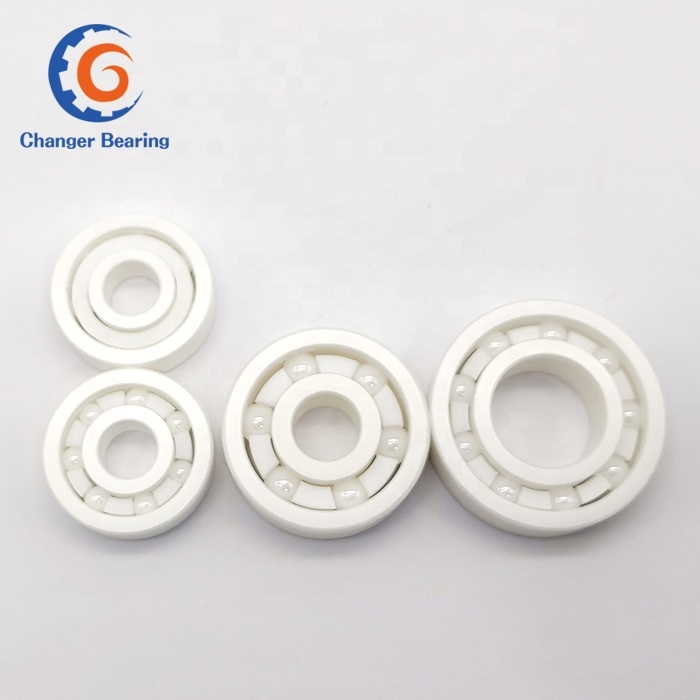
A Full Ceramic Bearing is a bearing in which the main bearing components are manufactured entirely from ceramic materials.
This normally includes:
· Inner ring
· Outer ring
· Rolling elements
· Cage, depending on the bearing design
The choice of ceramic material depends on the operating conditions and the required performance.
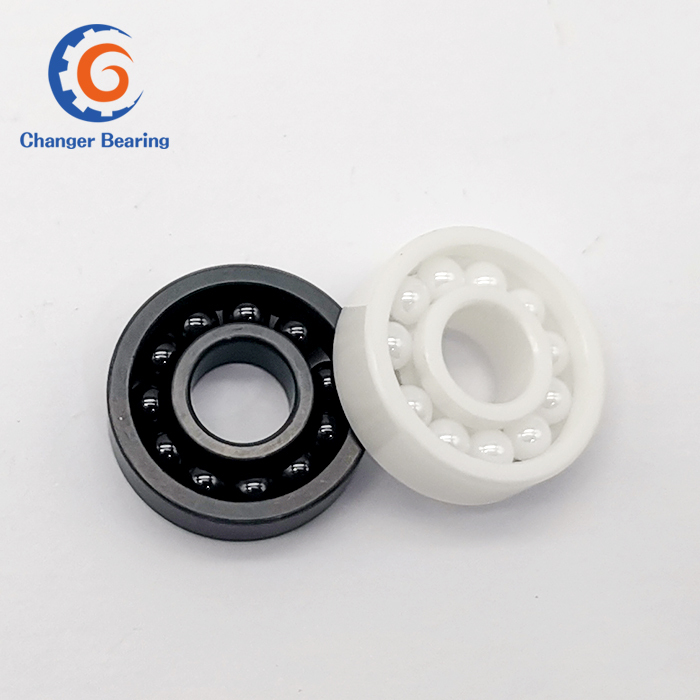
Silicon Nitride (Si₃N₄)
Silicon Nitride is one of the most widely used materials for high-performance ceramic bearings.
It offers high strength, good wear resistance, corrosion resistance, and relatively low density. These characteristics make Si3N4 Bearings suitable for high-speed and demanding applications.
Zirconia (ZrO₂)
Zirconia has good toughness and wear resistance, together with good resistance to elevated temperatures.
It can be considered where mechanical durability and chemical stability are important.
Alumina (Al₂O₃)
Alumina has high hardness and good thermal and chemical stability.
It is often selected for applications where chemical resistance and stable performance are more important than extremely high mechanical loads.
Silicon Carbide (SiC)
Silicon Carbide provides excellent resistance to wear, corrosion, and thermal shock.
It is particularly interesting for environments involving aggressive chemicals or severe temperature changes.
Why Are Full Ceramic Bearings Different?
The main difference is not simply that ceramic is a harder material than steel.
The real advantage comes from the combination of several properties.
Excellent Corrosion Resistance
Ceramic materials do not rust in the same way as conventional steel.
Full Ceramic Bearings can resist exposure to:
· Water
· Saltwater
· Moisture
· Many chemicals
· Corrosive environments
This makes them useful in marine equipment, chemical processing machinery, and applications where regular steel bearings would require more protection.
For equipment exposed to water or aggressive chemicals, corrosion resistance can have a direct impact on maintenance requirements and bearing life.
High-Temperature Capability
Another reason to use Full Ceramic Bearings is their ability to operate in demanding temperature conditions.
Ceramic materials maintain their properties over a wider temperature range than many conventional bearing materials. The source article gives an operating range of approximately -85°C to 800°C, although the actual allowable temperature depends on the ceramic material, cage, lubricant, seals, and bearing configuration.
For this reason, ceramic bearings may be considered for:
· Aerospace equipment
· High-temperature machinery
· Specialized medical equipment
· Vacuum systems
· Industrial processing equipment
It is important to check the complete bearing specification rather than assuming that every Full Ceramic Bearing can operate across the same temperature range.
Low Weight and Low Friction
Ceramic materials are lighter than steel.
The lower mass of the rolling elements can reduce inertia, which becomes particularly useful as rotational speed increases.
Lower friction can also help reduce:
· Heat generation
· Energy consumption
· Wear
· Lubrication demands
This is one reason Full Ceramic Bearings are often found in high-speed equipment and precision machinery.
Electrical Insulation
Ceramic materials are electrically insulating.
This is an important advantage in equipment where electrical current passing through the bearing could cause damage to the Raceway or Rolling Elements.
Full Ceramic Bearings can therefore be used in applications where electrical insulation is required.
Non-Magnetic Properties
Ceramic materials are also non-magnetic.
This makes Full Ceramic Bearings useful in equipment where magnetic interference must be minimized.
A typical example is medical equipment such as MRI machines, where conventional magnetic materials may not be suitable.
Types of Full Ceramic Bearings
Full Ceramic Bearings are available in several bearing configurations. The appropriate type depends on the load, speed, alignment, and mounting conditions.
1. Deep Groove Ball Bearings
Ceramic Deep Groove Ball Bearings are widely used when low friction, high speed, and precision are important.
Typical applications include:
· Electric motors
· Robotics
· High-speed machinery
· Precision instruments
Their relatively simple structure also makes them suitable for many general rotating applications where ceramic materials are required.
2. Angular Contact Ball Bearings
Angular Contact Ball Bearings are designed to carry both radial and axial loads.
Full ceramic versions can be used in high-speed applications such as:
Machine tool spindles
Precision machinery
High-speed rotating equipment
They are particularly useful where both load capacity and rotational accuracy are important.
3. Thrust Ball Bearings
Thrust Ball Bearings are designed primarily for axial loads.
Ceramic versions may be used in:
Pumps
Centrifuges
Turbomachinery
Specialized rotating equipment
4. Self-Aligning Ball Bearings
Self-Aligning Ball Bearings are designed to accommodate a certain degree of misalignment between the shaft and housing.
Ceramic versions may be considered for rotating machinery where shaft deflection or alignment variation is present.
5. Insert Bearings
Insert Bearings are convenient to install and can provide good resistance to moisture and chemicals when manufactured with suitable ceramic materials.
They may be useful in equipment operating in corrosive or wet environments.
6. Tapered Roller Bearings
Tapered Roller Bearings are designed to support both radial and axial loads.
They are commonly associated with heavy-duty applications such as automotive wheel hubs, conveyors, and mining equipment.
A ceramic Tapered Roller Bearing, however, is a specialized solution and should be selected according to the actual load and operating conditions.
7. Cylindrical Roller Bearings
Cylindrical Roller Bearings are mainly used where high radial load capacity is required.
Ceramic versions can offer lower friction and good thermal performance while maintaining the basic load-carrying characteristics of this bearing design.
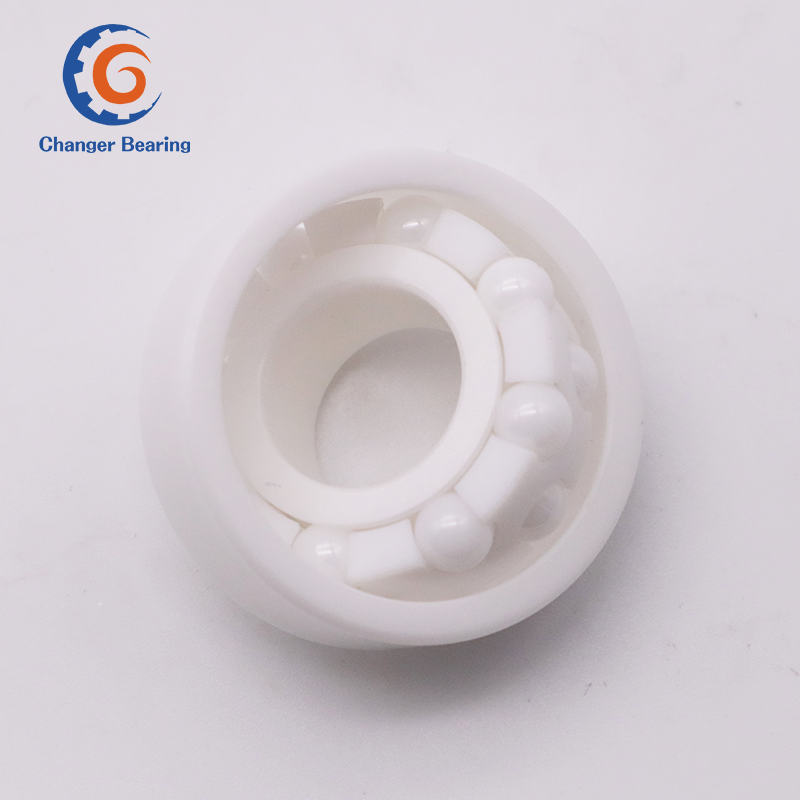
8. Flanged Ball Bearings
Flanged Ball Bearings include a flange on the outer ring, which can simplify positioning and mounting.
They are particularly useful where installation space is limited or where the bearing needs to be located precisely within a compact assembly.
Where Are Full Ceramic Bearings Used?
Full Ceramic Bearings are not normally chosen simply because they are more advanced than steel bearings.
They are selected when one or more ceramic properties provide a clear benefit to the machine.
Aerospace
Aerospace equipment can involve high temperatures, high rotational speeds, strict weight requirements, and demanding operating conditions.
Ceramic bearings can be used in systems such as:
· Jet engines
· Turbines
· High-speed rotating equipment
Their low weight, thermal stability, and resistance to wear can be valuable in these environments.
Medical Equipment
The medical industry is another important application area.
Si3N4 Ceramic Bearings may be used in:
· MRI equipment
· Surgical instruments
· Diagnostic equipment
· Medical rotating systems
Their non-magnetic and electrically insulating properties are especially useful for sensitive equipment.
Semiconductor Manufacturing
Semiconductor manufacturing requires clean and highly controlled environments.
Full Ceramic Bearings can be used in vacuum equipment and precision machinery because of their low friction, corrosion resistance, and non-magnetic characteristics.
Reducing contamination and maintaining precise movement are critical in these systems.
Marine and Offshore Equipment
Saltwater is highly corrosive to many metals.
Because ceramic materials provide excellent resistance to saltwater corrosion, Full Ceramic Bearings can be considered for:
· Marine engines
· Offshore equipment
· Water-handling systems
· Specialized marine machinery
The reduced corrosion risk can also help reduce maintenance requirements.
Chemical Processing
Pumps, valves, and rotating components in chemical plants may come into contact with aggressive chemicals.
Full Ceramic Bearings can provide a strong advantage in these environments because many ceramic materials have excellent chemical resistance.
The correct ceramic material still needs to be selected based on the specific chemical involved.
High-Speed Machinery
High rotational speed is another area where ceramic bearings can be useful.
Applications include:
· Dental drills
· Turbochargers
· Centrifuges
· High-speed electric motors
· Precision spindles
The lower mass and low friction of ceramic rolling elements can help reduce heat and maintain stable operation at high speed.
Full Ceramic Bearings vs. Hybrid Bearings
One of the most common questions is whether Full Ceramic Bearings are better than Hybrid Bearings.
The answer depends on the application.
A Hybrid Bearing uses ceramic balls together with steel rings. This provides some of the advantages of ceramic rolling elements while retaining the toughness and load-carrying ability of steel rings.
A Full Ceramic Bearing, on the other hand, uses ceramic material for both the rings and rolling elements.
| Feature | Hybrid Bearings | Full Ceramic Bearings |
|---|---|---|
| Construction | Steel rings + ceramic balls | Ceramic rings + ceramic balls |
| Speed | High | Very high potential |
| Corrosion Resistance | Moderate | Excellent |
| Thermal Stability | Good | Excellent |
| Electrical Insulation | Limited by steel rings | Excellent |
| Load Capacity | Generally higher | Generally lower |
| Shock Resistance | Better | Lower |
| Cost | Lower | Higher |
Hybrid Bearings are often a practical choice when high speed is needed but the machine still experiences significant loads or occasional shock.
Full Ceramic Bearings make more sense when corrosion resistance, electrical insulation, high-temperature capability, or extreme-speed performance is more important than maximum load capacity.
What Are the Main Disadvantages of Full Ceramic Bearings?
Ceramic bearings offer some impressive properties, but they are not suitable for every machine.
Higher Cost
Full Ceramic Bearings are considerably more expensive than standard steel bearings and are usually more expensive than Hybrid Bearings.
The reason is not only the cost of ceramic raw materials. Manufacturing ceramic rings and rolling elements to the required dimensional accuracy also requires specialized processes.
For this reason, their higher purchase price needs to be justified by the operating benefits.
Ceramic Is More Brittle Than Steel
Hardness does not necessarily mean toughness.
Ceramic materials are generally more brittle than steel. They can perform extremely well under suitable operating conditions, but sudden impacts or excessive shock loads can cause cracking or damage.
This is one of the most important differences between Full Ceramic Bearings and steel bearings.
Lower Load Capacity
Full Ceramic Bearings generally have a lower load capacity than comparable Hybrid Bearings or steel bearings.
They are therefore not usually the first choice for applications involving extremely high radial or axial loads.
If heavy-duty loading is the primary requirement, a conventional steel or Hybrid Bearing may be a better option.
More Specialized Applications
The combination of high cost, brittleness, and lower load capacity means that Full Ceramic Bearings are usually selected for specific applications rather than general-purpose machinery.
Their advantages become much more valuable when the equipment operates in conditions where steel bearings have obvious limitations.
How to Select a Full Ceramic Bearing
Choosing a Full Ceramic Bearing should start with the actual operating environment.
Before selecting a bearing, consider:
Speed:
Determine both continuous and peak rotational speed.
Load:
Check radial and axial loads, including shock loads.
Temperature:
Consider both normal operating temperature and temperature peaks.
Corrosion:
Identify whether the bearing will contact water, salt, chemicals, or other corrosive substances.
Electrical Conditions:
If electrical insulation is required, confirm that the complete bearing configuration provides it.
Magnetic Environment:
For equipment such as MRI systems, verify that the bearing materials are suitable for the magnetic environment.
Lubrication:
The lubricant must match the temperature, speed, vacuum conditions, and material combination.
Bearing Configuration:
Choose between Deep Groove Ball Bearings, Angular Contact Ball Bearings, Thrust Ball Bearings, or another configuration according to the actual load direction and machine design.
Shock and Impact:
If the machine experiences frequent impacts or sudden loads, a Hybrid Bearing may be more appropriate.
Are Full Ceramic Bearings Worth the Cost?
That depends on what the bearing needs to survive.
For a normal industrial machine operating at moderate speed in a clean, dry environment, a standard steel bearing may be the more economical solution.
But the calculation changes when the bearing is exposed to:
· Corrosive chemicals
· Saltwater
· Vacuum
· Extreme temperatures
· Electrical currents
· Magnetic fields
· Very high rotational speeds
In these situations, the additional cost of a Full Ceramic Bearing may be justified by longer service life, reduced maintenance, better operating stability, or the ability to operate where conventional bearings cannot.
The key is to evaluate the total operating cost, not just the initial bearing price.
FAQ
What is a Full Ceramic Bearing?
A Full Ceramic Bearing uses ceramic materials for the inner ring, outer ring, and rolling elements. Depending on the design, the cage may use another suitable material.
Are Full Ceramic Bearings better than steel bearings?
Not in every application.
Full Ceramic Bearings offer major advantages in corrosion resistance, electrical insulation, thermal stability, and high-speed operation. Steel bearings generally provide better toughness, load capacity, and cost efficiency.
What is the difference between Full Ceramic Bearings and Hybrid Bearings?
Hybrid Bearings use ceramic balls with steel rings, while Full Ceramic Bearings use ceramic materials for both the rings and rolling elements.
Hybrid Bearings usually provide a better balance between cost, load capacity, and speed. Full Ceramic Bearings are more suitable for extreme environments.
Can Full Ceramic Bearings operate at high temperatures?
Yes, ceramic materials can withstand high temperatures, but the actual temperature limit depends on the ceramic material, cage, lubricant, seals, and bearing configuration.
Always check the manufacturer's specification for the complete bearing assembly.
Are Full Ceramic Bearings corrosion resistant?
Yes. One of their main advantages is excellent resistance to water, salt, and many chemicals.
However, the complete bearing should be evaluated because the cage, seals, and lubricant may have different environmental limitations.
Can Full Ceramic Bearings be used in MRI machines?
Yes. Their non-magnetic and electrically insulating properties make suitable Full Ceramic Bearings a potential choice for MRI equipment and other sensitive medical systems.
Do Full Ceramic Bearings have a higher load capacity?
Generally, no.
Their main advantages are high-speed performance, corrosion resistance, thermal stability, and electrical insulation rather than maximum load capacity.
Final Thoughts
Full Ceramic Bearings are a specialized bearing solution for applications where conventional steel bearings may struggle.
Their combination of low friction, corrosion resistance, electrical insulation, non-magnetic properties, low weight, and thermal stability makes them particularly attractive for aerospace, medical equipment, semiconductor manufacturing, chemical processing, marine equipment, and high-speed machinery.
At the same time, they come with clear trade-offs. They cost more, are more brittle than steel, and generally have a lower load capacity.
So the right question is not simply whether Full Ceramic Bearings are "better."
The better question is whether the operating environment requires the properties that ceramic materials provide.
When high speed, corrosion resistance, extreme temperatures, electrical insulation, or non-magnetic performance are critical, the additional cost of a Full Ceramic Bearing can be justified. When those requirements are not present, a steel or Hybrid Bearing may remain the more practical choice.


