

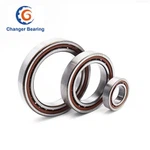


Ball Bearing
What Is Ball Bearing?
Ball Bearings are a type of rolling-element bearing that uses balls to maintain the separation between the moving parts of the bearing. The purpose of a ball bearing is to reduce rotational friction and support radial and axial loads. Radial ball bearings can support moderate radial loads and moderate axial loads (parallel to the shaft). They can operate at high speeds very easily. Ball bearings with shields or seals for protection can be lubricated to last for the operating life. Sometimes ball bearings are also called “deep groove ball bearings.”
Advantages of Ball Bearing
Reduced friction
Ball bearings reduce friction by replacing sliding contact with rolling contact. This results in less heat generation and wear, making them more efficient and long-lasting.
Load distribution
Ball bearings evenly distribute the load across the rolling elements, allowing them to support both radial and axial (thrust) loads. This feature is crucial for various machinery and applications.
Low maintenance
Ball bearings require minimal maintenance due to their durability and ability to operate smoothly over extended periods without frequent lubrication or adjustment.
Precision and accuracy
They are known for their precision, which is vital in applications where precise and accurate movement is necessary, such as in machine tools, automotive transmissions, and robotics.
Quiet operation
Ball bearings produce less noise and vibration compared to sliding or bushing-type bearings, making them suitable for applications where noise reduction is important.
Versatility
Ball bearings are available in a wide range of sizes, designs, and materials to suit different applications. Common materials include steel, stainless steel, and ceramics.
High-speed capability
They can handle high rotational speeds, making them ideal for applications where rapid motion is required.
Corrosion resistance
Stainless steel and ceramic ball bearings offer excellent resistance to corrosion, making them suitable for applications in harsh environments.
Temperature tolerance
Ball bearings can operate effectively within a wide temperature range, depending on the materials used. Specialized bearings can handle extreme temperatures.
Long service life
With proper care and maintenance, ball bearings can have a long service life, reducing the need for frequent replacement.




Why Choose Us
Our Factory
Our factory covers more than 20,000 square meter land including 16,000 square meters workshop space, and we have more than 200 skillful staff.
Our Certificate
We also have own brands, CHGER, REMOTIONER, and obtain ISO, SGS, RoHS certificates. We accept ALIBABA assurance.
High Quality
We take pride in the craftsmanship of our products and ensure that each one meets our strict standards for quality.
Fast Delivery
The delivery speed is fast, and the delivery will be sorted out for you as soon as the order is placed.
Types of Ball Bearing
Deep-groove ball bearing
This is the most widely used ball-bearing type in the world. It is because of its versatility and overall performance. They are characterized by having very deep raceway groves where the outer and inner rings have arcs with a slightly larger radius than balls. They also have a non-separable ring in them. They are excellent for high radial load capacity and high speeds, and they can accept axial loads in both directions.
Angular contact ball bearing
In this type of ball bearing, the direct line that connects the outer ring and inner ring balls have a given angle in the radial direction (contact angle). This type of angle is generally designed with three different kinds of contact angles. These bearings can bear axial loads but must be used in pairs or in combination because the contact angle cannot be used singly.
Self-aligning ball bearing
The self-aligning ball bearings include a double row of balls which are guided by a double row inner ring raceway and cage. They also contain the special features of a continuous spherical outer ring allowing the inner ball/ring complement to swivel within the outer ring. This type of bearing is recommended when the alignment of the shaft and bearing is a problem that a shaft could deflect. Self-aligning roller bearings are more suitable for absorbing these radial forces.
Duplex angular contact ball bearing
These are bearings that pair two or more angular ball bearings in a tandem, back-to-back, or face-to-face arrangement. Bearings that are duplex face-to-face (df) or back-to-back (db) may support axial loads in both directions. In comparison to face-to-face duplex bearings, back-to-back duplex bearings may support more moment loads. Tandem duplex bearings are more axially load-bearing than single bearings in a single direction.
Four-point contact ball bearing
These bearings have a distinctive design where the inner ring is divided into two halves, resulting in four points of contact. It is between the balls and raceways under radial stresses, hence the term "four-point contact." as a result, these roller bearings can support axial loads traveling in both directions as well as a mix of radial and axial loads. Compared to angular contact bearings, these bearings are built to endure higher load capacities and more demanding environments. They work best with heavy weights that oscillate often.
Application of Ball Bearing
Automotive industry
Ball bearings are widely used in automobile engines, transmissions, and wheel bearings. They make rotating easier, which lowers friction and improves performance all around.
Industrial machinery
Ball bearings are used in manufacturing machines, electric motors, and conveyor systems in industries. Their longevity and accuracy support effective operations.
Home appliances
Ball bearings are used in common appliances such as blenders, fans, and washing machines. Their presence guarantees these devices' silent and seamless operation.
Aerospace technology
Ball bearings are essential in aerospace applications such as aircraft engines and navigation systems. In this industry, their high precision and lightweight design are especially valued.
Medical equipment
When it comes to medical equipment, efficiency counts. Smooth movement is essential in many medical instruments, including scanning machines and surgical tools using ball bearings.
Components of Ball Bearing
Bearing ring
The ring part of a radial rolling bearing with one or several raceways.
Bearing washers
Ring parts of thrust rolling bearings with one or several raceways.
Intermediate retaining ring
A separable ring in a roller bearing with two or more rows of rollers, used to isolate and guide the rollers in two rows.
Oblique retaining ring (separable)
A separable ring with an "l" cross-section and its outer part is used as a rib for the inner ring of a radial cylindrical roller bearing.
Flat retaining ring
A separable, substantially flat washer, with its inner or outer part as a rib for the outer or inner ring of a radial cylindrical roller bearing.
Stop ring
A single-port ring with a constant cross-section, installed in an annular groove to axially position the rolling bearing in the housing or on the shaft.
Lock ring
A single-port ring with a constant cross-section, which is installed in the annular groove as a retaining ring to keep the roller or cage in the bearing.
Spacer
It is a ring-shaped part used between two bearing rings or bearing washers, or between two halves of bearing rings or between two halves of bearing washers, so as to maintain the specified axial distance between them.
Sealing ring
An annular cover composed of one or several parts, fixed on a ring or washer of the bearing and contacting another ring or washer or forming a narrow labyrinth gap to prevent leakage of lubricant and intrusion of foreign objects.
Material of Ball Bearing

Bearings made of stainless steels
Stainless steel materials are used to make bearing components because it is more resistant to surface corrosion due to the higher content of chromium (~18%) with the addition of nickel. The chromium reacts with oxygen to form a layer of chromium oxide on the surface, creating a passive film.

Martensitic stainless steel bearings– acd34 / ks440 / x65cr13
Many miniature bearing manufacturers make their rings and balls with a stainless steel material with slightly lower carbon and chromium content than aisi 440c known under several names including acd34, ks440, and x65cr13. After heat treatment, this material has smaller carbides so the bearing will have superior low noise characteristics while offering the same corrosion resistance as 440c.

Martensitic stainless steel bearings- aisi 440c
The carbon content in 400 series stainless steels is high enough so it can be hardened using standard heat-treating methods up to rc58. Due to the lower hardness, the load carrying capacity is 20% lower in bearings made from this material, than they are with 52100 chrome steel bearings. The level of carbon content means the components are magnetic. The corrosion resistance is “good”, when 440c material is exposed to fresh water and mild chemicals.

Martensitic stainless steel bearings– sv30
Martensitic stainless steel can be modified during the processing of the raw steel by lowering the carbon content and introducing nitrogen as an alloying element. The nitrogen increases the saturation of the chromium which transforms into chromium nitrides, instead of chromium carbides. The result is a high strength, high hardness steel with a superior microstructure that extends fatigue life by as much 100% (double) in certain applications.
Handle with care
Bearings are delicate enough to get damaged quickly. As such, it is very important that they are stored horizontally in a clean and dry environment with their packaging intact. Do not expose them to any airborne contaminants, as even a tiny speck of dirt can cause premature failure. Never hammer or pound them, or apply a direct force on it or its outer ring, which can cause damage to the rolling elements, resulting in misalignment. The most important thing to remember is to never remove bearings from their packaging until ready for use.
Check the bearing housing and shaft
Whenever a bearing is used for mounting, it is crucial that the housing and shaft are inspected for any sort of physical condition or damage. Always use a soft cloth to wipe the surfaces clean and make sure any nicks and burrs are removed.
Mount the bearings correctly
The method used to mount the bearings depends on the type of bearing. For example, bearings with cylindrical bores are generally mounted through a press fit method. Bearings with tapered bores can be mounted directly on tapered or cylindrical shafts with the use of tapered sleeves. However, pressure should be applied only with a press fit because without it the raceways can become damaged.
Avoid preheating or overheating
The maximum heating allowed on the bearings depends on the heat treatment of the material. If they are heated above the permitted limit, they can permanently deform or soften the bearing steel, lowering load carrying capacity and resulting in a failure. Always heat the bearings using induction heaters, and never with an open flame.
Always use the proper tools
Specialized tools like bearing pullers, bearing fitting tool kits, oil injector kits, hydraulic nuts, or induction heaters should be used in the mounting and dismounting processes. These tools ensure the smooth process of mounting or dismounting, in order to minimize the risk of damage.
Avoid corrosion
It is crucial that you should not expose bearings to the presence of water for a long time, as it will lead to rust and corrosion. It will also cause the premature failure of the bearings, which can affect the machine performance and productivity. As a result, it will increase your operating costs. Also, make sure to wear gloves when handling bearings. Perspiration can also lead to rust and corrosion.
Proper lubrication
If you want to have a prolonged life of your bearings, it is crucial that they should be properly lubricated. The correct lubricant depends on the environmental conditions, temperature, speed and load. In this case, it is advisable that you should follow your manufacturer's recommendations.
Heat and harden
This is followed by the hardening phase. Here, the ring is heated at a temperature of 1,565°f for 15 to 20 minutes. The ring is then quenched in oil at 375° f for 15 to 20 minutes. The next step is to temper the ring at a temperature of 340°f for about two hours.
Grind to size
The ring is then ground using a specialized grinding machine to produce the desired finished product size. Raceway grinding helps to achieve raceway position, geometry and radius. Face grinding ensures that the ring has the proper bearing width. The inner ring is then ground with the inner bore and at the same time the outer ring is ground with the outer ring.
Select the material and cut the ring
The initial process involves using an automatic machine to cut the ring into the recommended shape. The excess material left behind after cutting is usually machined.
Stamp bearings with manufacturing information
The second step is to print the necessary manufacturing information and bearing number on the outer ring surface. Visit our bearing numbering system to learn more about bearing numbers.
Make the final touches
Finally, the seat is honed to produce a perfect surface finish and geometry.
Rolling Bearing Selection Criteria


Available space
A bearing's bore diameter, one of the primary dimensions, is usually determined by the machine's design and its shaft diameter. Small-diameter shafts can be fitted with any type of ball bearing. In addition to deep groove ball bearings, needle roller bearings can also be used. Bearings for large-diameter shafts include cylindrical, taper, spherical, and deep groove ball bearings. In situations where radial space is limited, small cross-section bearings are preferable.
Loads
A bearing's size is usually determined by the magnitude of the load. In general, roller bearings support heavier loads than similar-sized ball bearings, and bearings with a full complement of rolling elements can accommodate heavier loads than caged bearings. In general, ball bearings support light to moderate loads. Bearings with rollers are usually the more appropriate choice when bearings must support heavy loads or when shaft diameters are large.
Misalignment
Misalignments are caused by shafts bending under load, when bearing seatings are not machined to the same height, or when bearings are spaced too far apart. Deep groove ball bearings as well as cylindrical roller bearings cannot accommodate any misalignment or can only accommodate minor misalignments unless by force. Bearings that self-align such as spherical roller bearings, and spherical roller thrust bearings can accommodate misalignment and compensate for initial misalignment caused by machining and mounting errors.
Precision
Arrangements that require high running accuracy and applications that require very high speeds require bearings with a higher precision. This is typically the case in medical and aerospace applications. High precision bearings are typically made according to deep groove ball bearing or angular contact bearing standards, but have much smaller tolerances then standard bearings.
Speed
A rolling bearing's speed is limited by the permissible operating temperature. For high-speed operation, bearings with low friction and consequently low heat generation inside them are most suitable. Thrust bearings, by their design, cannot accommodate as fast a speed as radial bearings.
Quiet running
Depending on the application, for example, small electric motors for household appliances or office machines, the noise generated in operation can influence the bearing selection. A particular type of deep groove ball bearing with a brass cage is produced for these applications. These bearings have more space between the raceways, which enables a higher amount of lubricant to be placed inside the bearing, dampening noise levels.
Stiffness
A rolling bearing's stiffness is determined by the magnitude of its elastic deformation under load. Since deformations are typically minimal, they can usually be neglected. The stiffness of spindle bearing arrangements or pinion bearing arrangements is critical. Roller bearings have a higher degree of stiffness than ball bearings due to the contact conditions between the rolling elements and raceways. However, this deformation does play a role in lubrication. Under a hydro-elastic lubrication regime this deformation is a favorable effect, learn more in our tribology guide.
Mounting and dismounting
When bearings with cylindrical bores have separable designs, they can be mounted and dismounted more efficiently, especially if interference fits are required on both rings. If frequent mounting and dismounting is required, separable bearings are preferable since each bearing ring can be fitted independently of the other. Tapered bore bearings can easily be mounted on a cylindrical shaft seating or a tapered journal using an adapter or withdrawal sleeve. Learn more about bearing installation in our bearing puller article.
How the Ball Bearing Works
Load distribution
When a load or force is applied to the bearing, it is transmitted through the outer race to the balls and then to the inner race. The load is distributed evenly among the balls, which reduces the pressure on any individual point of contact.
Rolling motion
The balls in the bearing rotate freely between the raceways, allowing smooth rolling motion with minimal friction. The spherical shape of the balls ensures that they contact the raceways at a small contact area, reducing friction and wear.
Separation of races
The balls act as rolling elements that separate the inner and outer races, preventing direct contact between them. This separation reduces friction, as compared to sliding contact between the races.
Cage or retainer
The cage or retainer holds the balls in position, evenly spacing them around the bearing. It prevents the balls from colliding with each other and helps maintain their proper alignment within the raceways.
Lubrication
To further minimize friction and wear, ball bearings are often lubricated with grease or oil. The lubricant forms a thin film between the balls and the raceways, reducing friction and dissipating heat generated during operation.
Efficiency and load capacity
The design of ball bearings allows for efficient transmission of rotational motion with relatively low friction. The use of rolling elements (balls) distributes the load more evenly, allowing ball bearings to handle both radial and axial loads.
Our Factroy
Hangzhou Changer Bearing Co., Ltd. is one of the leading and professional suppliers in bearings and power transmission in China since 2013 year. Meanwhile, REMOTIONER INDUSTRIAL LIMITED supplies industrial tools, gear motors, etc. Our factory covers more than 20,000 square meter land including 16,000 square meters workshop space, and we have more than 200 skillful staff. Based on the casting lines for supplying complete ranged products.

Our Certificate
We also have own brands, CHGER, REMOTIONER, and obtain ISO, SGS, RoHS certificates.

FAQ